

oduigy.over-blog.com/
18 Février 2021

No one is going to become a VBA expert in one day. Excel VBA is a journey of time and practice. The good news is that plenty of resources are out there that can help you on your path to Excel VBA prowess. Here, you discover ten of the most useful places to turn to for Excel VBA help when you need an extra push in the right direction.
Sorry if this is a dumb question, but I'm new to learning the subtle intricacies of excel. I just crafted my first excel spreadsheet that runs a VBA macro on my computer, but when I go to open it on the mobile app (iOS if it matters), I can't make use of the feature because it says 'This version of excel can't run VBA macros.' VBA has no ROUND function, but Excel does. Therefore, to use ROUND in this statement, you tell VBA to look for the Round method (function) in the Application object (Excel). You do that by adding the word Application before the word Round. Use this syntax whenever you need to access an Excel function from a VBA. Even though Excel is available on the iOS and Android stores as a free download, it does not support VBA. Office-js (based on JavaScript) is the extensibility solution that Microsoft will be supporting on all Excel endpoints. If you rewrite your VBA code in Office-js, it. Even though Excel is available on the iOS and Android stores as a free download, it does not support VBA. Office-js (based on JavaScript) is the extensibility solution that Microsoft will be supporting on all Excel endpoints. If you rewrite your VBA code in Office-js, it can be used with Excel on both iOS and Android.
One of the best places to get macro help is the macro recorder in Excel. When you record a macro with the macro recorder, Excel writes the underlying VBA for you. After recording, you can review the code, see what the recorder did, and then try to turn the code it creates into something more suited to your needs.
For example, say you need a macro that refreshes all the pivot tables in your workbook and clears all the filters in each pivot table. Writing this macro from a blank canvas would be a daunting task. Instead, you can start the macro recorder and record yourself refreshing all the pivot tables and clearing all the filters. After you stop recording, you can review the macro and make any changes you deem necessary.
To a new Excel user, the Help system may seem like a clunky add-in that returns a perplexing list of topics that has nothing to do with the original topic being searched. The truth is, however, after you learn how to use the Excel Help system effectively, it's often the fastest and easiest way to get extra help on a topic.
You need to remember two basic tenets of the Excel Help system:
The dirty secret about programming in the Internet-age is that there is no original code anymore. All the macro syntax that will ever be needed has been documented somewhere on the Internet. In many ways, programming has become less about the code you can create from scratch, and more about how to take existing code and apply it creatively to a particular scenario.
If you're stuck trying to create a macro for a particular task, describe the task you're trying to accomplish via your favorite search engine. For the best results, enter 'Excel VBA' before your description.
For example, if you're trying to write a macro that deletes all blank rows in a worksheet, search for, 'Excel VBA delete blank rows in a worksheet.' You can bet two months' salary that someone has tackled the same problem and posted example code that gives you the nugget of information you need to jump start ideas for building your own macro.
If you find yourself in a bind, post your question in a forum to get customized guidance based on your scenario.
User forums are online communities that revolve around a particular topic. In these forums, you can post questions and have experts offer advise on how to solve particular problems. The folks answering the questions are typically volunteers who have a passion for helping the community solve real-world challenges.
Many forums are dedicated to all things Excel. To find an Excel Forum, type 'Excel Forum' in your favorite search engine.
Here are a few tips for getting the most out of user forums:
There are a few dedicated Excel Gurus that share their knowledge through blogs. These blogs are often treasure troves of tips and tricks, offering nuggets that can help build your skills. Best of all, they're free!
Although these blogs won't necessarily speak to your particular needs, they offer articles that advance your knowledge of Excel and can even provide general guidance on how to apply Excel in practical business situations.
Here is a list of a few of the best Excel blogs today:
If you find that you absorb video training better than articles, consider mining YouTube. Dozens of channels are run by amazing folks who have a passion for sharing knowledge. You'll be surprised at how many free high-quality video tutorials you can find.
Live and online training events are an awesome way to absorb Excel knowledge from a diverse group of people. Not only is the instructor feeding you techniques, but the lively discussions during the class are a wealth of ideas and new tips you may never even thought of. If you thrive in the energy of live training events, then consider searching for Excel classes.
Here are a few sites that provide excellent instructor-led Excel courses:
The Microsoft Office Dev Center is dedicated to helping new developers get a quick start in programming Office products.
Although the site can be a bit difficult to navigate, it's worth a visit to see all the free resources, including sample code, tools, step-by-step instructions, and much more.
Like finding gold in your backyard, the existing files in your organization are often a treasure trove for learning. Consider opening Excel files that contain macros, and have a look under the covers. See how others in your organization use macros. Try to go through the macros line-by-line and see if you can spot new techniques.
You could find a few new tricks you never thought of. You may even stumble upon entire chunks of useful code you can copy and implement in your own workbooks.
Do you have an Excel genius in your company, department, organization, or community? Make friends with that person today. What you have there is your own personal Excel forum.
Most Excel experts love sharing their knowledge. So don't be afraid to approach your local Excel Guru to ask questions or seek advice on how to tackle certain macro problems.
No one is going to become a VBA expert in one day. Excel VBA is a journey of time and practice. The good news is that plenty of resources are out there that can help you on your path to Excel VBA prowess. Here, you discover ten of the most useful places to turn to for Excel VBA help when you need an extra push in the right direction.
One of the best places to get macro help is the macro recorder in Excel. When you record a macro with the macro recorder, Excel writes the underlying VBA for you. After recording, you can review the code, see what the recorder did, and then try to turn the code it creates into something more suited to your needs.
For example, say you need a macro that refreshes all the pivot tables in your workbook and clears all the filters in each pivot table. Writing this macro from a blank canvas would be a daunting task. Instead, you can start the macro recorder and record yourself refreshing all the pivot tables and clearing all the filters. After you stop recording, you can review the macro and make any changes you deem necessary.
To a new Excel user, the Help system may seem like a clunky add-in that returns a perplexing list of topics that has nothing to do with the original topic being searched. The truth is, however, after you learn how to use the Excel Help system effectively, it's often the fastest and easiest way to get extra help on a topic.
You need to remember two basic tenets of the Excel Help system:
The dirty secret about programming in the Internet-age is that there is no original code anymore. All the macro syntax that will ever be needed has been documented somewhere on the Internet. In many ways, programming has become less about the code you can create from scratch, and more about how to take existing code and apply it creatively to a particular scenario.
If you're stuck trying to create a macro for a particular task, describe the task you're trying to accomplish via your favorite search engine. For the best results, enter 'Excel VBA' before your description.
For example, if you're trying to write a macro that deletes all blank rows in a worksheet, search for, 'Excel VBA delete blank rows in a worksheet.' You can bet two months' salary that someone has tackled the same problem and posted example code that gives you the nugget of information you need to jump start ideas for building your own macro.
If you find yourself in a bind, post your question in a forum to get customized guidance based on your scenario.
User forums are online communities that revolve around a particular topic. In these forums, you can post questions and have experts offer advise on how to solve particular problems. The folks answering the questions are typically volunteers who have a passion for helping the community solve real-world challenges.
Many forums are dedicated to all things Excel. To find an Excel Forum, type 'Excel Forum' in your favorite search engine.
Here are a few tips for getting the most out of user forums:
There are a few dedicated Excel Gurus that share their knowledge through blogs. These blogs are often treasure troves of tips and tricks, offering nuggets that can help build your skills. Best of all, they're free!
Although these blogs won't necessarily speak to your particular needs, they offer articles that advance your knowledge of Excel and can even provide general guidance on how to apply Excel in practical business situations.
Here is a list of a few of the best Excel blogs today:
If you find that you absorb video training better than articles, consider mining YouTube. Dozens of channels are run by amazing folks who have a passion for sharing knowledge. You'll be surprised at how many free high-quality video tutorials you can find.
Live and online training events are an awesome way to absorb Excel knowledge from a diverse group of people. Not only is the instructor feeding you techniques, but the lively discussions during the class are a wealth of ideas and new tips you may never even thought of. If you thrive in the energy of live training events, then consider searching for Excel classes.
Here are a few sites that provide excellent instructor-led Excel courses:
The Microsoft Office Dev Center is dedicated to helping new developers get a quick start in programming Office products.
Although the site can be a bit difficult to navigate, it's worth a visit to see all the free resources, including sample code, tools, step-by-step instructions, and much more.
Like finding gold in your backyard, the existing files in your organization are often a treasure trove for learning. Consider opening Excel files that contain macros, and have a look under the covers. See how others in your organization use macros. Try to go through the macros line-by-line and see if you can spot new techniques.
You could find a few new tricks you never thought of. You may even stumble upon entire chunks of useful code you can copy and implement in your own workbooks.
Do you have an Excel genius in your company, department, organization, or community? Make friends with that person today. What you have there is your own personal Excel forum.
Most Excel experts love sharing their knowledge. So don't be afraid to approach your local Excel Guru to ask questions or seek advice on how to tackle certain macro problems.
Excel VBA is a powerful tool which enables the automation of tasks in Excel. It can be used to automate many repetitive tasks along with more complex applications. This quick tip guide shows you how to open the Excel Visual Basic Editor (aka Excel VBA Editor) and get started with VBA programming in Excel. Having access to the VBA editor lets you write your own VBA code or review recorded macros. Read on to see How to Open and Start Using the MS Excel VBA Editor
To open Excel visual basic editor,
Click the visual basic button on the developer tab.
If the Developer tab is not present, go to File -> Options -> customize ribbon and tick Developer.
You can also open VBA in Excel using Alt + F11 keyboard shortcut.
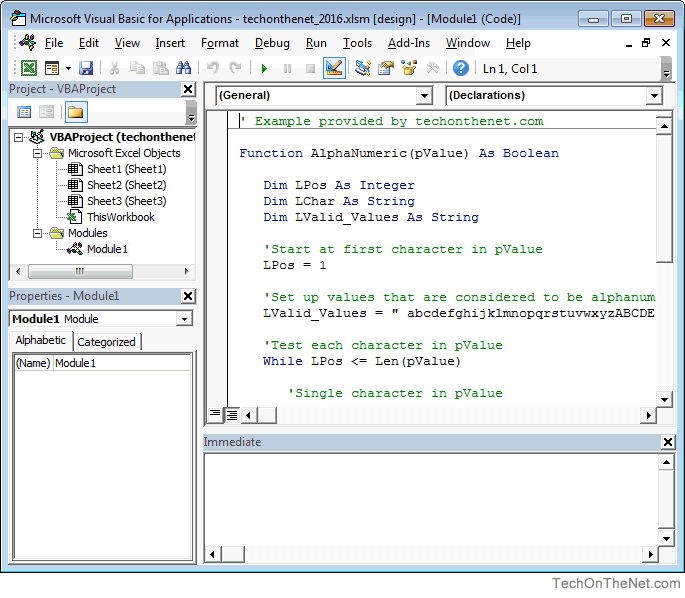
Great, now you're in the editor, what is it? Microsoft Excel's Visual basic editor can be referred to as, VBA editor, VB editor and even VBE. It is all the same thing. It's the place where you can create macros and write scripts in Excel VBA.
The most basic sections of the editor is the Project View in which you can see modules listed down the left hand side. Think of this like a folder for your macros. Modules contain the code that is required for your macros to work. Its beyond the scope of this article to go into how to split out your code into objects but modules gives the user a powerful tool to create efficient and well organized code.
To get started writing code you will need to create a new module. Add a new module in VBA editor by clicking on VBAProject(Book1), right click, Insert Model. Delete a module by simply right clicking, Remove Module. Excel will prompt you to confirm before deleting.
Recording a macro in Excel is a great way to automate tasks as well as a great tool to help learn more VBA code. A common trick is to record a macro and then review the VBA code to see how it works. Now you know how to open the VBA editor in Excel you should be able to record a macro, open the editor and view the code. You'll see the system generated VBA can be messy but it will give you the key snippets of code needed for the desired action. These can be things as simple as formatting, copying, pasting, deleting or selecting a sell. Alternatively, you could get quite advanced and carry out entire tasks before going into the Excel visual basic editor to review the code.
The world really is your oyster when you get started recording macros in excel. Top tip is to start with small steps. You can always bulk all your small macros into one at a later stage but when it comes to reviewing each step its useful to keep it separate, at least when you are first getting started.
Once you have entered the VBA editor, created a module and written some code you will want to run the code.
To run VBA code in VBA editor simply click the Run Macro button which is shaped like a small green triangle on the toolbar. You can also Run Macro in Excel VBA editor by pressing F5 shortcut.
This is a very quick introduction to show you how to open VBA in excel, create a new module and also run your macro once written. To write some actual code, as we have suggested above, a great tip is to record macros and then go back and review the code in the MS Excel VBA editor. You'll be surprised how messy the generated VBA can get but it will give you the key snippets of VBA code you need to get started with Excel VBA programming and is a great way of learning the syntax of VBA. Alternatively, Google is your best friend when it comes to writing macros. So what are you waiting for, press Alt + F11 in Excel and get coding in VBA!
What to do next? REad our quick Introduction to VBA for MS Excel


/image%2F6308928%2F20210221%2Fob_dc9f37_download-microsoft-word-for-windows-10.jpeg)
/image%2F6308928%2F20210221%2Fob_3b0cce_where-is-the-ip-address-located-on-xbo.jpeg)
/image%2F6308928%2F20210221%2Fob_544d1a_air-display-windows-7-64-bit.jpeg)
/image%2F6308928%2F20210221%2Fob_70c33c_screenshot-shortcut-windows-10.jpeg)